

When it comes to building a sustainable house in Australia, you shouldn’t just consider sustainability as a standalone feature. Every decision you make throughout the project should reflect your sustainability goals.
That’s why Australian homeowners must think about their site, local climate, design, materials, energy use, and long-term performance of their home as part of the same project. Doing this will ensure that your home isn’t just sustainable but comfortable, efficient, and affordable to run too.
This guide by The Rubix will break down nine practical steps to help you get started on your sustainable house project.
1. Define Your Sustainable House Goals
Before looking at the floor plans or sustainable building materials, decide what you want your sustainable house to achieve as sustainability can mean different things for different households.
For one homeowner, the priority might be reducing energy bills. For another, it could be creating a comfortable home that needs less heating and cooling, reducing water consumption, or reducing the home's environmental impact.
So, start by identifying what your priorities are as it will influence almost every decision that follows, including the size and layout of your home, the materials you choose, and where you allocate your budget.
2. Assess Your Site before Designing the House
One of the most important principles when building a sustainable house is to design your house for the site rather than using a generic layout.
Before finalising your building design, assess your site for orientation, solar access, seasonal winds, overshadowing, slope, soil, drainage, and potential climate-related risks. Your building designer/ architect can help you with this.
This analysis will help you decide what’s possible for your site and how you can make the best layout for your sustainable home so it meets both your lifestyle and sustainability goals. Check our guide on building a house in Australia to know what you should be prepared for.
3. Design for Your Local Australian Climate
Each climate zone in Australia requires a different approach. For instance, in warmer climates the focus is often on limiting unwanted solar heat gain, providing effective shading, natural ventilation, and capturing cooling breezes.
Similarly, in cooler climates, your priorities may shift towards capturing useful winter sunlight, retaining heat, insulation, and using thermal mass effectively. You should also consider airtightness alongside proper ventilation to maintain thermal stability and comfort.
Passive design brings these principles together so you don’t rely entirely on mechanical heating and cooling systems. It uses elements such as orientation, insulation, glazing, shading, ventilation, and thermal mass to work with your local climate. You can check our guide on the best building materials for Sydney’s climate for deeper insights.
4. Set the Budget for Your Sustainable House
Sustainability should be part of your budget from the beginning and not an add-on after you’ve completed the main design. Depending on your site and climate, you should prioritise different sustainability features in your budget.
Instead of picking the cheapest option for being economical or assuming the most expensive technology is the best investment, consider the upfront cost alongside expected energy savings, maintenance requirements, durability, and replacement costs.
In many cases, a well-oriented, appropriately insulated, and climate-responsive home can reduce the amount of energy needed in the first place. You can then build on this foundation by adding renewable energy systems and efficient appliances.
5. Choose the Right Design Team
Your architect or building designer has an important role in turning your sustainability goals into a practical energy efficient house design. Look for a professional who understands climate-responsive and energy-efficient design, rather than simply someone who can add sustainable products to an existing floor plan.When speaking to potential designers, ask questions such as:
- How do you approach passive solar design?
- How will you assess my site and climate?
- How do you balance sustainability with the project budget?
- How will the home's energy performance be assessed?
- What materials and construction systems do you commonly work with?
- How will sustainability considerations be incorporated throughout the design?
At The Rubix, we help you navigate through every part of building a sustainable house from assessing your site, planning and designing the house, and getting approvals for its construction.
6. Select Materials based on Their Whole-of-Life Performance
A material may have a lower environmental impact at the manufacturing stage but require frequent maintenance or replacement. Another may have a higher initial impact but provide excellent durability and a long service life.
That’s why while choosing sustainable building materials, you should check their whole-of-life impacts rather than looking at individual products in isolation. Consider factors like their embodied energy and environmental impact, durability, maintenance requirements, thermal performance, and expected lifespan.
The materials you choose to build your energy efficient house with will influence its performance, durability, energy use, and environmental impact.
You can check our guide to explore the best sustainable building materials for your project.
7. Plan Energy and Water Efficiency from the Start
An energy efficient house should not depend entirely on renewable energy to achieve good performance. Your first objective should be to reduce unnecessary energy demand through the building design itself.Passive design principles can help to reduce the amount of energy required for heating and cooling. For water efficiency you should consider adding water-efficient fixtures and appliances, efficient hot-water systems, rainwater collection, appropriate stormwater management, and native/ climate-suitable planting.
The right combination will depend on your local conditions, household requirements, and budget. But it’s important that you plan these systems alongside your house instead of trying to retrofit them after construction.
8. Plan for Construction Waste and Site Impact
Sustainability doesn't stop once you have planning approval. Your material selection and construction methods can influence how much waste is produced and how it affects the surrounding site.
So, you should consider designing efficiently to minimise unnecessary material use, order materials accurately, reuse suitable materials where practical, separate recyclable construction waste, and choose construction methods that reduce offcuts and waste.
Homeowners across Australia are using materials like prefabricated Cross Laminated Timber (CLT) panels for their quick and easy assembly that reduces waste generated on site and construction timeline. You can check our CLT projects here to see what’s possible.
9. Think about the Home's Long-Term Performance
A sustainable house shouldn't only perform well when it‘s brand new. It should continue to be comfortable, efficient and practical for many years. Before construction, think beyond the day you move in and consider:
-
The energy performance of your home and whether it will remain efficient as energy prices and household technologies change.
-
The durability and maintenance needs of the materials and systems you’ve used in your home.
-
Whether the house can accommodate changes to your household or lifestyle.
-
How future heat, rainfall, flooding, bushfire or other local risks will affect the property.
-
Monitoring the house to confirm whether it is performing as expected.
-
Thinking about these factors early can help you avoid designing a house that meets your needs today but becomes expensive or difficult to adapt later.
You can also check our guide to sustainable house design for deeper insights into sustainability features, different building materials, and the cost of constructing a sustainable house in Australia.
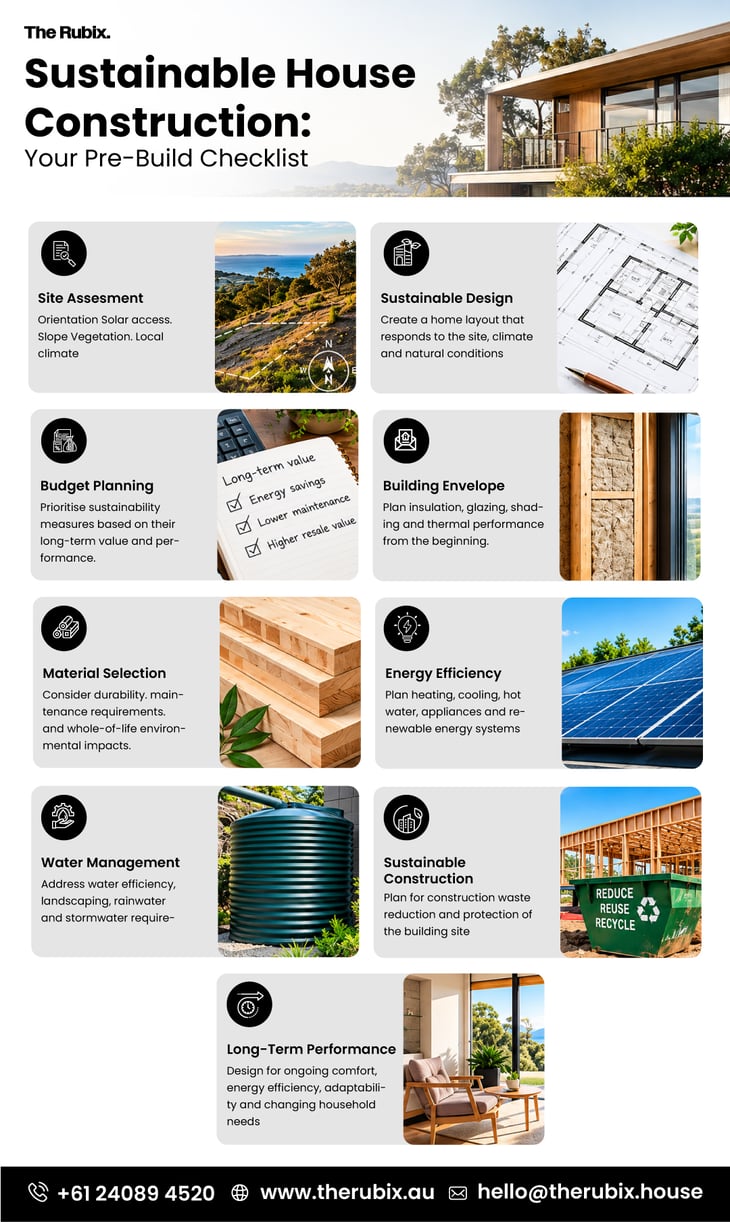
Sustainable House Checklist: What to Decide before Construction
Before the construction of your sustainable house begins, work through this checklist with your design team:
-
Site - Have your site assessed for orientation, solar access, slope, vegetation, and local climate.
-
Design - Make sure the layout of your house responds to your site's conditions.
-
Budget - Prioritise your sustainability measures according to their long-term value.
-
Building envelope - Plan insulation, glazing, shading, and thermal performance early in your project.
-
Materials - Assess your building materials for their durability, maintenance, and whole-of-life impacts.
-
Energy - Consider heating, cooling, hot water, appliances, and renewable energy.
-
Water - Make sure to address water efficiency, landscaping, and stormwater requirements.
-
Construction - Make a plan for reducing waste and protecting your site.
-
Long term - Evaluate what you can do to make the house remain comfortable, efficient, and adaptable as your needs change.
You don't need to make every decision at once. The important thing is to bring these questions into the project before key design and construction decisions have already been made.
It might be worth adding airtightness as a major consideration somewhere in one of the 9 categories. An airtight construction can cost more, but makes a huge difference to thermal stability and comfort.
Common Mistakes When Building a Sustainable House
Even homeowners with the best intentions can make sustainability harder or more expensive by approaching it in the wrong order. Here’s a list of some common mistakes that homeowners make while building their eco-friendly home:
-
Leaving sustainability until the end
This is perhaps the biggest mistake you can make. Once the orientation, floor plan, structure, and major materials have been decided, making fundamental changes becomes more limited. -
Treating sustainability as a list of add-ons
Adding solar panels, efficient appliances, and water-saving fixtures won't automatically create a sustainable house. You need to get the fundamentals right with a site-responsive and climate-appropriate design. -
Leaving sustainability until the end A technology that works well for one property may not provide the same value on another. So, start with an understanding of your site's conditions and your home's energy requirements.
-
Focusing only on the upfront cost
The cheapest option may not be the most cost-effective over the home's lifetime. Consider energy use, maintenance, durability, and replacement costs along with the upfront costs while choosing materials. -
Choosing materials based on labels alone
"Sustainable" isn't a complete assessment of a material's environmental performance. You should also consider its production, transport, durability, maintenance, and end-of-life potential. -
Making the house larger than necessary
A larger home generally requires more materials to build and more energy and resources to operate. Designing around your actual household needs can be a simple way to reduce unnecessary consumption.
Takeaway
Building a sustainable house in Australia requires more than adding a few sustainability features to your floor plan. You need to evaluate everything from your site’s orientation, its slope, your sustainability goals, and the lifecycle value of the materials you have in mind.
Your building designer/ architect can be a great help in this project to ensure that the layout of your house matches your sustainability goals along with your lifestyle needs. At The Rubix, we consider sustainability as part of your entire project instead of leaving it as an afterthought. Get in touch with our team to design your custom single and dual occupancy homes in Australia.
Frequently Asked Questions
1. Are sustainable houses more expensive?
Most sustainable houses have a higher upfront cost than traditional homes but they often save money over their life with reduced utility bills and maintenance costs.
There are some alternatives like CLT that can meet sustainability metrics and are cheaper to build depending on the site.
2. Is CLT suitable for sustainable house construction?
Yes, CLT is definitely suitable for sustainable house construction as it acts as an efficient Carbon sink, has high energy efficiency and excellent thermal performance. With its prefabrication, it’s quick to assemble and reduces waste on site.
3. How much does it cost to build a sustainable house in Australia?
The cost of building a sustainable house in Australia depends on factors like your site’s orientation, local climate, your choice of sustainable materials, and energy requirements.
4. How can I make a new house more energy efficient?
To make a new house more energy efficient you should ensure proper insulation and sealing, install glazed windows, and ensure your house orientation takes advantage of passive solar heating or natural shade depending on your local climate. Use energy efficient smart systems for heating and cooling, and add rooftop solar panels.
5. How can I reduce the environmental impact of building a house?
You can reduce the environmental impact of building a house by using sustainable materials, applying passive design principles, and installing renewable energy systems.