---
title: 10 Best House Building Materials for Sydney’s Climate
description: Explore the best house building materials for Sydney's climate. Compare CLT and eco-friendly options for stronger, sustainable, energy-efficient homes.
image: https://therubix.au/hubfs/10-Best-House-Building-Materials-for-Sydney%E2%80%99s-Climate.jpg
---
[](https://therubix.au)
- [HOME](https://therubix.au)
- [ABOUT](https://therubix.au/about)
- [PROJECTS](https://therubix.au/projects)
- [CONTACT](https://therubix.au/contact-us)
Follow us on
-
-
# 10 Best House Building Materials for Sydney’s Climate
 [Ken Slamet](https://therubix.au/blog/author/ken-slamet)
| Jun 29, 2026
As the global temperatures continue to rise, homeowners are becoming more conscious of how their homes respond to the changing climatic conditions. In Sydney, where hot summers, humidity, and seasonal rainfall are common, building materials play a critical role in ensuring a comfortable indoor temperature throughout the year.
Many homeowners are also prioritising construction materials that reduce their energy consumption and support their sustainability goals.
In this guide by The Rubix, we’ll explore ten such sustainable house building materials that perform exceptionally well in Sydney's climate, so you build a home that’s climate-responsive and energy-efficient too.
## What Makes a Construction Material Suitable for Sustainable Homes?
With the rising energy costs, increased awareness of climate change, and stricter sustainability standards, homeowners are prioritising eco-friendly construction materials in Australia.
The factors that make a building material suitable for sustainable homes includes:
- High Thermal Mass: Energy-efficient materials absorb heat and release it slowly as the environment cools. Such materials like concrete, rammed earth, and brick stabilise the indoor temperature effectively.
- Superior Insulation: Natural materials like cellulose, sheep's wool, hempcrete, and cork prevent heat transfer and reduce the overall heating and cooling demands.
- **Low Embodied Carbon:** Eco-friendly materials like sustainably harvested timber or recycled steel require minimal energy to manufacture, source, and transport. This lowers the carbon footprint of your eco-home.
- **Low Toxicity (VOCs):** Finishes like natural clay plasters, silicate paints, and zero-VOC oils are free from harmful volatile organic compounds (VOCs) and chemical binders. This ensures an excellent indoor air quality.
- **Durability and Reusability:** Many eco-homes prioritise using construction materials that can be easily repurposed or biodegraded at the end of the building's life.
To learn more, check out our guide on [sustainable homes in Australia](https://therubix.au/blog/sustainable-house-australia-complete-guide).
## How Sydney’s Climate Influences Sustainable Material Selection
Sydney's humid subtropical climate presents several challenges for residential construction. Hot summers, intense UV exposure, seasonal rainfall, and coastal humidity can affect a home's comfort, energy consumption, and long-term durability.
As a result, sustainable material selection in Sydney goes beyond environmental impact. Homeowners should prioritise materials that offer strong thermal performance, moisture resistance, and long-term durability.
By choosing such climate-responsive building materials, it is possible to create homes that remain comfortable year-round while reducing energy use and supporting sustainability goals.
You can also check out our [knockdown rebuild guide](https://therubix.au/blog/complete-knockdown-rebuild-guide-australia), if you are planning to rebuild your house.
## Sustainable and Climate-Responsive House Building Materials for Sydney
### 1. Cross-Laminated Timber (CLT)
[Cross-Laminated Timber (CLT)](https://therubix.au/blog/is-cross-laminated-timber-sustainable) is an engineered wood product made by layering timber boards in alternating directions and bonding them together under pressure. This process creates large, structurally strong panels that can be used for walls, floors, and roofs.
Why it’s suitable for Sydney homes:
- Stores carbon throughout its lifecycle
- Excellent thermal insulation properties
- Requires significantly less energy for its production
- Maintains comfortable indoor temperatures during Sydney's hot summer
- Fast and efficient construction process
- Suitable for Passive house (passivhaus) and energy-efficient homes
Check out our guide to learn more about [how CLT is a sustainable choice for Australian homes](https://therubix.au/blog/building-with-clt-smart-sustainable-homes-in-australia).
### 2. Engineered Timber Framing
Engineered timber framing offers a sustainable alternative to traditional Australian construction materials. Products such as laminated veneer lumber (LVL) and glue-laminated timber (Glulam) are being preferred for their superior strength, stability, and consistency.
Why it’s suitable for Sydney homes:
- Renewable and sustainably sourced
- Less prone to warping or shrinking due to changing temperature and humidity conditions
- High strength-to-weight ratio
- Reduced construction waste
- Excellent thermal performance
### 3. Hempcrete
Hempcrete is a relatively new sustainable construction material. It is made from hemp hurds (the woody core of the hemp plant), lime-based binders, and water. While it is not typically used as a load-bearing material, it serves as an excellent infill solution for walls, providing both insulation and environmental benefits.
Why it’s suitable for Sydney homes:
- Carbon-negative material, absorbs more CO2 than it releases during crop production and construction process
- Exceptional thermal and acoustic insulation
- Naturally resistant to mould and pests
- Breathable and regulates moisture effectively with its porous structure
- Highly fire-resistant especially helpful for bushfire-prone areas
- Low environmental impact
### 4. Recycled Brick and Masonry
Reclaimed bricks and recycled masonry products offer a practical way to reduce construction waste while maintaining the durability and thermal performance of traditional brick construction.
Why it’s suitable for Sydney homes:
- Provides high thermal mass to regulate indoor temperatures
- Reduces waste in landfills
- Lower embodied carbon
- Excellent durability
### 5. Insulated Concrete Forms (ICFs)
Insulated Concrete Forms combine reinforced concrete with integrated insulation panels to create highly energy-efficient wall systems. This results in a sustainable building that has superior thermal performance and structural strength.
Why it’s suitable for Sydney homes:
- Outstanding thermal efficiency
- Resistance to moisture and extreme weather
- Enhanced sound insulation
- Reduced energy costs
- Long-term durability
### 6. Fibre Cement Cladding
Fibre cement cladding has become a popular choice for modern Australian homes due to its versatility, durability, and resistance to environmental factors. They are designed to withstand harsh UV exposure, moisture, and changing weather conditions.
Why it's suitable for Sydney homes:
- Resistant to moisture, rot, and termites
- Performs well in coastal environments
- Non-combustible material
- Long service life
- Available in a wide range of finishes
### 7. High-Performance Insulation Materials
Effective insulation is one of the most important components of a sustainable home. Advanced insulation materials such as cellulose, sheep's wool, cork, and recycled polyester help reduce heat gain during summer and heat loss during winter.
Why it’s suitable for Sydney homes:
- Improved energy efficiency
- Lower heating and cooling costs
- Reduced greenhouse gas emissions
- Better indoor comfort
- Enhanced acoustic performance
### 8. Double or Triple-Glazed Windows
Windows play a significant role in a home's overall energy performance. Double and triple-glazed windows use multiple panes of glass separated by insulating air or gas-filled cavities to minimise the transfer of heat.
Why it’s suitable for Sydney homes:
- Superior thermal insulation
- Reduces energy consumption
- Improves noise reduction
- Enhances indoor comfort
- Better control of solar heat gain
### 9. Recycled Steel
Steel remains one of the most durable construction materials available. Recycled steel offers the added benefit of reducing environmental impact without compromising on the structural performance of your house.
Why it’s suitable for Sydney homes:
- Highly durable and long-lasting
- Resistant to termites and pests
- Fully recyclable
- Reduces the embodied carbon associated with production of new steel
### 10. Green Roofing and Composite Roofing Systems
Sustainable roofing systems are becoming increasingly common in environmentally conscious home designs. Green roofs incorporate vegetation layers that provide natural insulation, while composite roofing systems utilise recycled and durable materials to improve performance.
Why it’s suitable for Sydney homes:
- Improve energy efficiency
- Reduce urban heat island effect
- Enhance rainwater management
- Increase the lifespan of roof
- Greater environmental sustainability
## How to Choose the Right Construction Material for Your Home
There’s no single best construction material but the right material for your residential project will depend on your budget, sustainability goals, design preferences, and site conditions.
The table below compares the key strengths of the ten construction materials we discussed above, so you can identify which one’s the most suitable for your Sydney home.
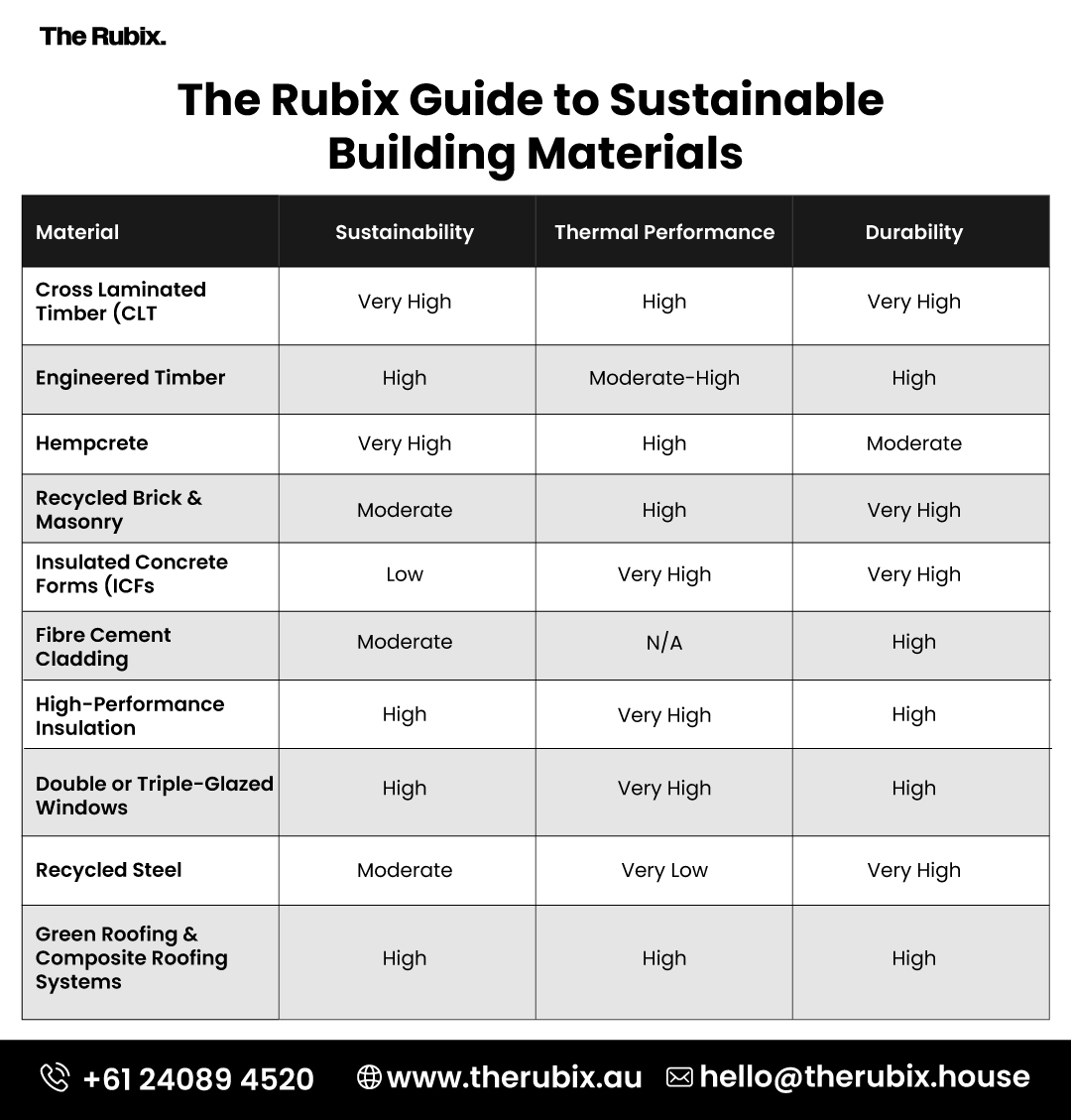
The most effective way to build a sustainable home is to combine construction materials that complement one another, balancing thermal performance, durability, environmental impact, and budget considerations.
An experienced building designer or architect can help you select the right combination of materials and design a house that meets your sustainability goals.
## The Future of House Building Materials in Australia
The rising construction costs, shortage of skilled labor, and strict energy efficiency (NatHERS) standards in Australia is driving the construction industry away from the traditional brick construction.
House building materials are rapidly shifting toward sustainable alternatives and high-performance thermal materials that are easier to assemble and provide year round comfort. Innovations in engineered timber, bio-based materials, recycled construction products, and energy-efficient building systems are already transforming the residential construction industry.
This shift is critical as by investing in sustainable building materials today, homeowners can create homes that are better equipped to meet future environmental challenges.
## Takeaway
Sydney's subtropical climate, coupled with growing sustainability and energy-efficiency expectations, has encouraged homeowners to rethink their construction choices.
More people are embracing sustainable and climate-responsive building materials as a result. Using these construction materials in Australia improves indoor comfort, reduces energy consumption, and supports long-term environmental goals.
Suitable options include engineered timber and hempcrete to high-performance insulation and recycled materials. Choosing the right material can significantly enhance your home's durability, thermal performance, and overall sustainability.
At The Rubix, we combine sustainable house building materials with energy-efficient design principles to create homes that are comfortable, resilient, and built for the future. [Contact us](https://therubix.au/contact-us) to discover which materials will align well with your lifestyle, budget, and sustainability goals.
## FREQUENTLY ASKED QUESTIONS
#### 1. What are the best house-building materials for Sydney’s climate?
The best house building materials for Sydney’s climate are the ones that balance high thermal mass with insulation for a regulated indoor temperature year-round. Materials like CLT, reclaimed brick, and Insulated Concrete Forms (ICFs) perform well in the hot, humid summers, and mild winters of Sydney.
#### 2. How does Sydney’s climate affect building material choices?
The subtropical climate of Sydney requires building materials that manage the summer heat, humidity, and intense UV rays effectively. Properties like humidity and moisture resistance, high thermal mass, energy efficiency, and long-term durability are highly preferred by homeowners.
#### 3. What is the most durable construction material for homes in Australia?
The most durable construction materials for homes in Australia are Insulated Concrete Forms (ICFs) and CLT as they offer better resistance to the country’s environmental threats like bushfires, severe storms, and termites.
#### 4. What are the most energy-efficient house building materials?
The most energy-efficient house building materials include hempcrete, Cross Laminated Timber (CLT) and rammed earth.
#### 5. Is timber a good building material for Sydney’s weather?
Yes, timber is a good building material for Sydney’s weather. Sealed engineered timber & CLT fare especially well in Sydney’s humidity due to its moisture-resistance, thermal efficiency, and bushfire resistance.
[Building Materials](https://therubix.au/blog/tag/building-materials)
#### Subscribe to Our Newsletter!
### Free Trial
[](https://therubix.au/)
- [About](https://therubix.au/about)
- [Projects](https://therubix.au/projects)
- [Blog](https://therubix.au/blog)
- [Contact](https://therubix.au/contact-us)
Connect with us:
© The Rubix, 2026
Legal | Privacy | Cookies Settings
```json
{
"@context" : "https://schema.org",
"@type" : "BlogPosting",
"author" : {
"@type" : "Person",
"name" : "Ken Slamet",
"url" : "https://therubix.au/blog/author/ken-slamet"
},
"dateModified" : "2026-07-21T05:47:28.809Z",
"datePublished" : "2026-06-29T06:55:13.000Z",
"headline" : "10 Best House Building Materials for Sydney’s Climate",
"image" : [ "https://therubix.au/hubfs/10-Best-House-Building-Materials-for-Sydney%E2%80%99s-Climate.jpg" ],
"mainEntityOfPage" : {
"@id" : "https://therubix.au/blog/best-house-building-materials-sydney-climate",
"@type" : "WebPage"
},
"publisher" : {
"@type" : "Organization",
"logo" : {
"@type" : "ImageObject",
"url" : "https://therubix.au/hubfs/The-Rubix-Collective-Logo-Black.svg"
}
}
}
```
```json
{
"@context" : "https://schema.org",
"@type" : "FAQPage",
"mainEntity" : [ {
"@type" : "Question",
"acceptedAnswer" : {
"@type" : "Answer",
"text" : "The best house building materials for Sydney’s climate are the ones that balance high thermal mass with insulation for a regulated indoor temperature year-round. Materials like CLT, reclaimed brick, and Insulated Concrete Forms (ICFs) perform well in the hot, humid summers, and mild winters of Sydney."
},
"name" : "What are the best house-building materials for Sydney’s climate?"
}, {
"@type" : "Question",
"acceptedAnswer" : {
"@type" : "Answer",
"text" : "The subtropical climate of Sydney requires building materials that manage the summer heat, humidity, and intense UV rays effectively. Properties like humidity and moisture resistance, high thermal mass, energy efficiency, and long-term durability are highly preferred by homeowners."
},
"name" : "How does Sydney’s climate affect building material choices?"
}, {
"@type" : "Question",
"acceptedAnswer" : {
"@type" : "Answer",
"text" : "The most durable construction materials for homes in Australia are Insulated Concrete Forms (ICFs) and CLT as they offer better resistance to the country’s environmental threats like bushfires, severe storms, and termites."
},
"name" : "What is the most durable construction material for homes in Australia?"
}, {
"@type" : "Question",
"acceptedAnswer" : {
"@type" : "Answer",
"text" : "The most energy-efficient house building materials include hempcrete, Cross Laminated Timber (CLT) and rammed earth."
},
"name" : "What are the most energy-efficient house building materials?"
}, {
"@type" : "Question",
"acceptedAnswer" : {
"@type" : "Answer",
"text" : "Yes, timber is a good building material for Sydney’s weather. Sealed engineered timber & CLT fare especially well in Sydney’s humidity due to its moisture-resistance, thermal efficiency, and bushfire resistance."
},
"name" : "Is timber a good building material for Sydney’s weather?"
} ]
}
```