

ith rising energy costs, extreme weather, and growing awareness about climate change, homeowners in Australia are looking for ways to build sustainable homes. And building such eco-friendly houses requires the right construction materials.
The material you choose influences everything from the energy efficiency and indoor comfort to the durability, and maintenance of your home.
In this guide by The Rubix, we’ll discuss some important factors that you should consider before choosing your building materials and the best options for different parts of a sustainable home.
Why the Choice of Building Material Matters More than You Think
The materials you choose to build your home with doesn’t just affect how it looks. It affects how well your home performs over time, like how much energy it uses, how well it can handle extreme weather, and its maintenance needs.
By choosing the right materials for your sustainable house you can:
- Improve thermal performance, reducing your heating and cooling costs.
- Improve durability and minimise your ongoing maintenance.
- Enhance your indoor comfort throughout the year.
- Lower the environmental impact of your construction.
- Create healthier indoor environments.
- Improve resilience against Australia's climate conditions.
But there isn’t a single "perfect" material that ticks all the boxes. What you need is the right combination of materials for your site, climate, and lifestyle requirements.
5 Things to Consider before Choosing Materials for Building a Sustainable House
Every home is different and so is the combination of materials that will work best for it. Before comparing materials, it's worth understanding which factors will have the biggest impact on the long-term performance of your house.
Here’s a list of factors that you must consider before choosing materials for your sustainable home:
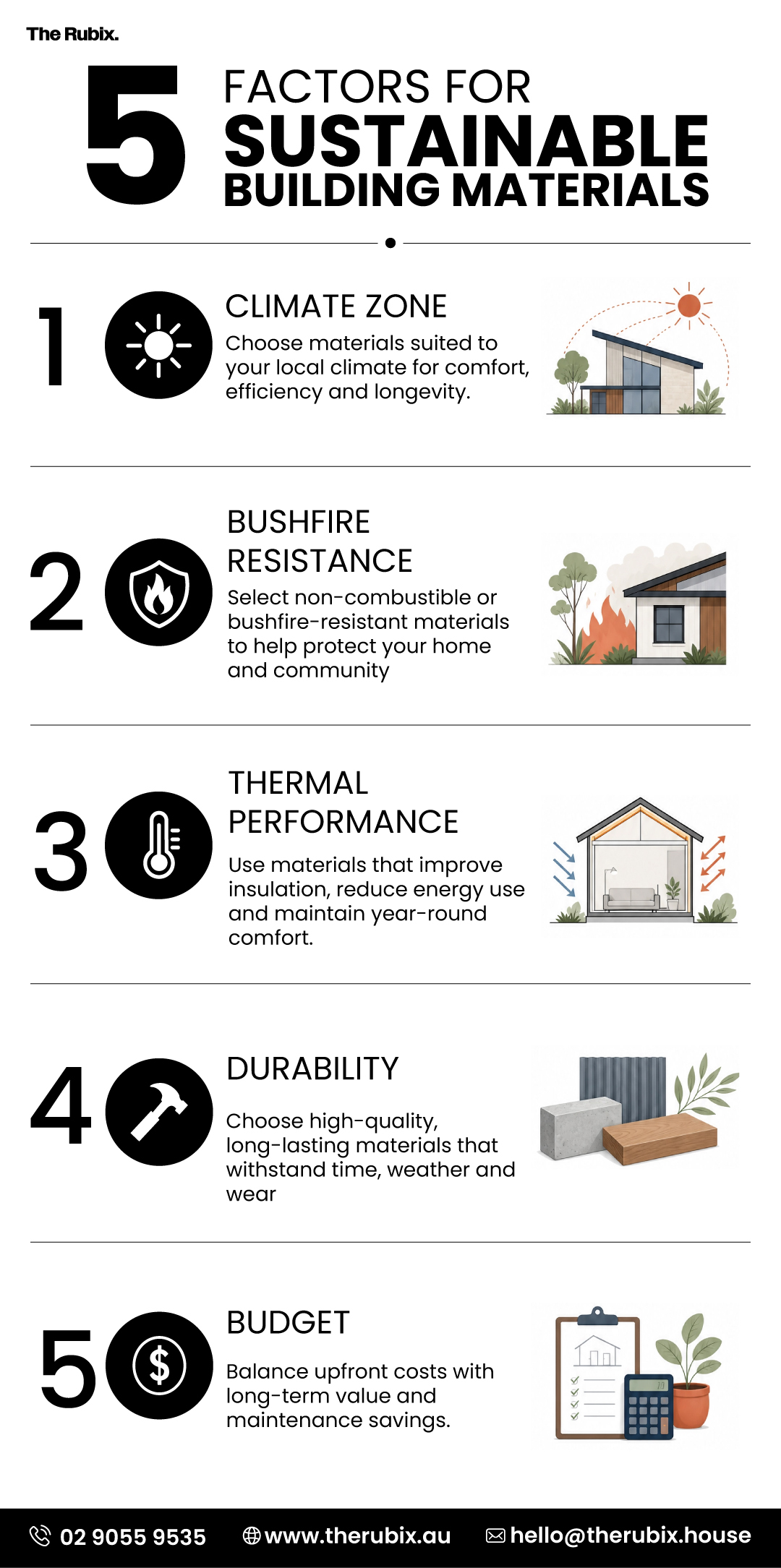
1. Australia's Climate Zone
The climate zones in Australia range from cool alpine regions,temperate southern states,tropical northern climates to dry inland areas. Materials that perform well in one location may not deliver the same results somewhere else.
For example, homes in cooler climates often benefit from materials with good thermal mass that help retain warmth while homes in hotter regions typically perform better with lightweight construction, reflective roofing and effective natural ventilation.
For tropical climates, moisture resistance and airflow are important considerations - but are less important in other areas. So, it’s important that you design your house for your local climate from the outset.
2. Bushfire and Weather Conditions
Your local environment also plays a major role in your material selection. For bushfire-prone areas, your external building materials must be suitable for your property's Bushfire Attack Level (BAL). You can choose non-combustible cladding, fire-resistant roofing and appropriate glazing to improve the resilience of your home.
Similarly, coastal homes need materials that can withstand the salt-laden air and higher humidity, while areas with heavy rainfall or strong winds benefit from durable, weather-resistant materials that require less ongoing maintenance.
3. Thermal Performance and Insulation
Heating and cooling account for a significant portion of your energy use, thermal performance is therefore one of the most important considerations when building a sustainable house.
Instead of focusing on insulation alone, think about how the entire building envelope works together. Your walls, roof, floors, windows and insulation should complement each other to reduce unwanted heat gain in summer and minimise heat loss during winter.
This is also where the role of your building designer/ architect becomes more important to help you pick the right materials so your home stays more comfortable naturally.
4. Maintenance and Lifespan
Unlike what most believe, sustainability isn't just about choosing recycled or renewable materials. It's also about selecting materials that continue to perform well over time.
When comparing your building materials, consider how they'll respond to UV exposure, moisture, termites, corrosion and general wear. Select a durable product that's well suited to your environment as it’s a more sustainable choice in the long run.
5. Budget and Long-Term Running Costs
It's natural to compare materials based on their upfront cost but the cheapest option doesn't always offer the best value. Higher-performing materials may cost more initially yet they can reduce your energy bills, require less maintenance and last considerably longer.
Look at the whole-life cost of a material rather than just its purchase price for a better choice. This doesn’t mean you should get the most expensive product but invest in materials that offer a balance in performance, durability and efficiency while staying in your budget.
If you’re considering rebuilding check ourguide on sustainable knockdown rebuild in Australia.
The Best Building Materials for Different Parts of a Sustainable House
As every part of your home has a different job to do, the right material for one area may not be the best choice for another. Instead of focusing on a single "green" material, it's better to select materials that work well together to improve durability, energy efficiency and long-term performance.
Let’s discuss which building materials are best suited for the different parts of your sustainable home:
Structural Frame
The structural frame of your home affects its strength, construction method and environmental footprint. You can choose responsibly sourced engineered timber including Cross Laminated Timber (CLT) for its low environmental footprint, quick construction, and long-term performance. You can read our guide on Is Cross Laminated Timber Sustainable to learn more about CLT.
Recycled steel is another option that offers excellent durability, termite resistance and structural stability. The right choice for you depends on your design, budget and site conditions.
External Walls
The external walls don’t just define the appearance of your home but help to regulate indoor temperatures, provide protection against the weather, and contribute to the overall energy efficiency of your home.
Sustainable options for building external walls include materials like recycled brick that provides valuable thermal mass to stabilise your indoor temperatures, fibre cement is widely used for its durability and performance in coastal and bushfire-prone areas. Hempcrete is another suitable option if you’re prioritising energy efficiency.
Insulation
You shouldn’t consider insulation as a standalone product. It should be considered as a part of your home's overall thermal envelope - roof, wall and floor insulation all work together to reduce heat transfer. It helps to maintain comfortable indoor temperatures throughout the year.
Recycled polyester, cellulose insulation made from recycled paper and sheep's wool are all sustainable options. These perform well when selected for the local climate and installed as part of a well-designed building envelope.
Flooring
Flooring contributes to both the environmental footprint of your home and its day-to-day comfort. Sustainable options like engineered timber and reclaimed hardwood reduce the demand for new materials, while polished concrete can improve thermal performance in homes designed to utilise thermal mass effectively.
Roofing
Roofing plays an important role in protecting your home and limiting its heat gain. Insulated metal roofing is a popular choice in many Australian climates due to its durability, reflectivity and compatibility with rainwater harvesting.
Another great option is a green roof made of living plants that provides thermal insulation, absorbs heat, UV rays, and heavy rainfall. The key is selecting a roofing system that complements the rest of your building envelope rather than considering it in isolation.
Which Building Material Is Best for Your Australian Climate?
Climate-responsive design is one of the basic foundations of a sustainable house in Australia. By choosing materials that suit your local environment, you can improve comfort, reduce maintenance and increase the lifespan of your home.
Let’s discuss sustainable building materials that are suitable for different Australian climates.
Coastal Homes
Coastal environments present unique challenges due to salt-laden air, strong winds and higher humidity levels. You should choose materials that resist corrosion and moisture in these conditions.
Fibre cement cladding, corrosion-resistant steel, aluminium joinery and durable composite products are commonly used as they require less maintenance and can withstand the harsh coastal conditions. Proper detailing and ventilation are equally important here to manage moisture and extend the life of external building materials.
Bushfire-Prone Areas
Building in a bushfire-prone location requires careful material selection to improve resilience and comply with your property's Bushfire Attack Level (BAL).
Non-combustible materials such as fibre cement cladding, steel roofing, and appropriately rated glazing are commonly used as they reduce vulnerability to radiant heat and ember attack. Your material selection should always be a part of an overall bushfire-responsive design rather than being considered in isolation.
Contact the building designers at The Rubix to discuss how you can use engineered wood like CLT for such areas.
Cold Regions
Homes in cooler parts of Australia benefit from materials that retain warmth and support passive solar design. Thermal mass, high-performance insulation and airtight construction all help to maintain stable indoor temperatures during winter.
Materials such as brick, concrete and engineered timber can all perform well when integrated into an appropriately designed building envelope. The key here is reducing heat loss while making the most of the winter sunlight available.
Hot & Humid Regions
In hot and humid climates, keeping heat and moisture out of the home is often the biggest priority. You can benefit from lightweight construction, reflective roofing, well-ventilated roof spaces and moisture-resistant materials.
Natural cross ventilation, shading and appropriate insulation work together with these materials to reduce your reliance on air conditioning. Instead of relying on a single product, successful sustainable homes combine multiple design strategies that suit tropical conditions.
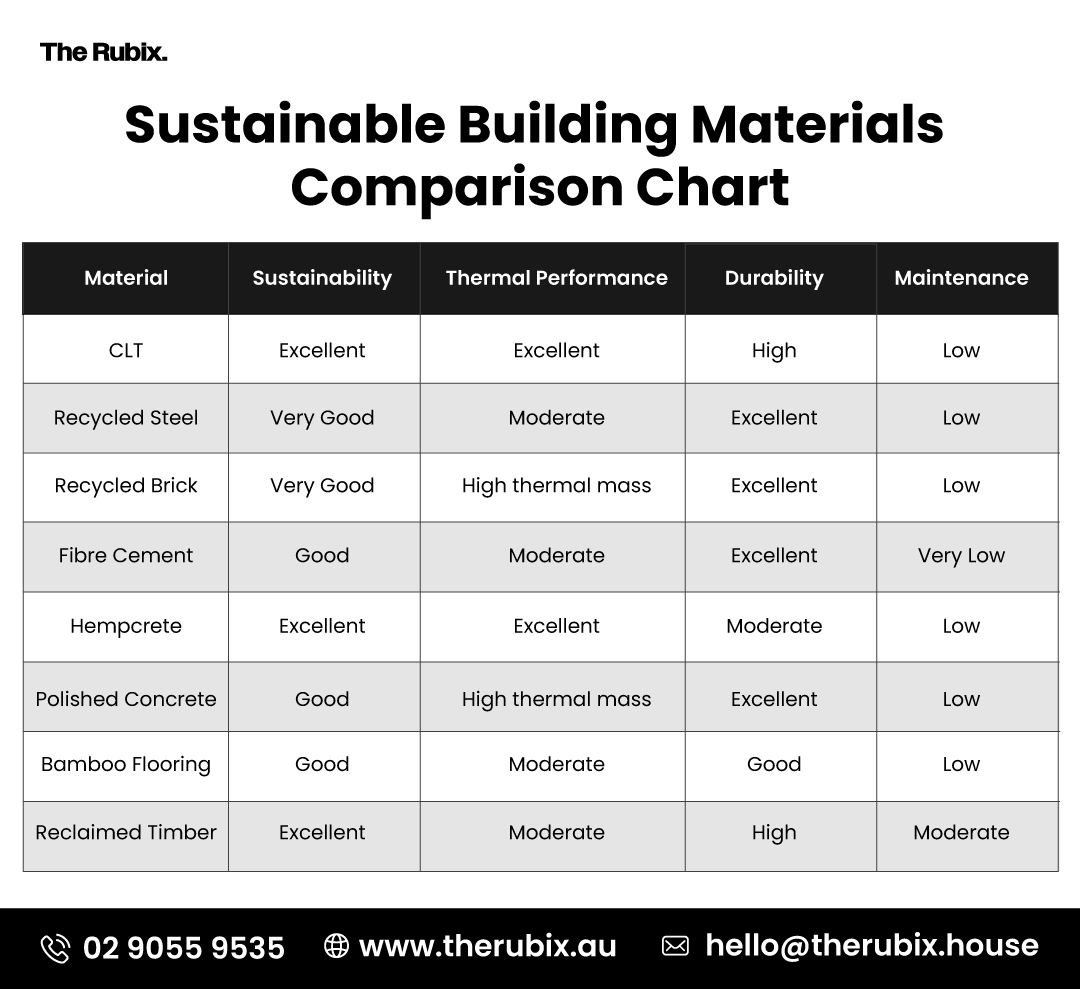
Comparing Different Sustainable Building Materials
Common Mistakes to Avoid When Choosing Sustainable Building Materials
When it comes to choosing sustainable building materials it isn't just about selecting products with the lowest environmental impact.
Even after hours of research, many homeowners end up making some common mistakes, avoiding these early in your planning process can save you both time and money later.
Some of these mistakes are:
- Choosing materials based on their upfront cost alone.
- Ignoring local climate and site conditions.
- Overlooking bushfire or coastal requirements.
- Focusing on individual materials instead of considering the entire building envelope.
- Prioritising appearance over long-term durability and maintenance.
An experienced building designer can help you make the right pick so you not only get better performance and lower ownership costs but also don’t compromise on the design of your home. Get in touch with The Rubix to discuss your options.
Expert Tips for Building a Sustainable House that Lasts
To sum up our discussion, remember that every sustainable home is different but a few principles apply to almost every project. These are:
- Design your home for your climate before selecting the materials.
- Invest in quality insulation and high-performing windows.
- Choose durable materials that require minimal maintenance.
- Consider the lifetime costs of the material and not just its initial purchase price.
- Work with experienced building designers who understand the Australian building requirements and sustainable design principles.
Thoughtful planning from the beginning helps to create a home that's more comfortable to live in, cheaper to run, and built to perform well for decades.
Final Thoughts
When it comes to building a sustainable house, there's no single material that's best for every project. The right choice depends on your climate, site conditions, budget, and the way your home is designed.
You should select materials that work well together rather than focusing on a single choice. This will help you create a home that's more energy efficient, durable and comfortable year-round.
If you're planning to build a sustainable house or a knockdown rebuild, the team at The Rubix can help you make informed material and design decisions that suit your lifestyle, your site, and Australia's unique conditions. Contact us to discuss your project.
Frequently Asked Questions
1. What is the most sustainable building material for a house in Australia?
While there isn’t a single material that’s suitable for all sustainable houses, you can choose materials like CLT, hempcrete, rammed earth, recycled brick and steel, etc. You should select these sustainable building materials based on your site, climate conditions, and lifestyle requirements.
2. Is it more expensive to build a sustainable house in Australia?
Building a sustainable house in Australia does require a higher upfront investment but it often brings long term benefits in energy efficiency, lower utility bills, and enhanced property value.
3. What materials make a house more energy efficient?
Choosing materials with a high thermal mass, high-performance insulation, and specialised glazing make a house more energy efficient.
4. What should I consider before building a sustainable house?
There are a number of factors that you should consider before building a sustainable house. These include your site orientation, the local climate, the embodied carbon of the building material, its durability and maintenance needs, and thermal mass.
5. Are sustainable houses worth the investment?
Yes, sustainable houses are worth the investment as they offer year-round comfort, lower the utility bills, are energy efficient, and enhance the property’s resale value.