

When it comes to rebuilding a house, one of the major concerns that homeowners have is how quickly the costs can spiral out of control.
This is especially true for cities like Sydney where high labour costs, strict council regulations, and rising material prices can make budgeting feel uncertain. But with the right planning and decisions early on, you can keep your rebuild budget under control without compromising on the quality.
This guide by The Rubix will discuss in detail about the knockdown rebuild cost in Sydney and how you can keep your budget in check with our expert tips.
But before we get into the actual numbers, it’s important to understand what really drives the cost of a knockdown rebuild in Sydney.
What Factors Influence Knockdown Rebuild Costs
One of the main reasons homeowners struggle to estimate their knockdown and rebuild costs is because no two projects are exactly the same. There are several variables that can significantly impact your final budget and overlooking even one of them can lead to unexpected expenses.
Here are the key cost factors that you should be aware of:
1. Site Conditions
Sloping blocks, presence of asbestos in the soil that needs remediation, poor and loose soil quality, rock, or limited site access can increase the excavation, foundation, and labour costs.
2. Demolition Requirements
Factors like asbestos removal, structural complexity, and disposal requirements can add to the demolition costs.
3. Design Complexity
A simple, functional layout is far more cost-effective than a highly customised design. Features like split levels, large open spans, and intricate rooflines can increase both material and labour costs.
4. Material Selection
Your choice of materials both structural and aesthetic have a direct impact on your rebuild cost. Choosing premium finishes, imported materials, or custom elements can push your budget higher.
5. Labour Costs in Sydney
Sydney has one of the highest construction labour costs in Australia and longer build times or complex construction methods can significantly add to overall expenses.
6. Council Approvals and Regulations
Local council requirements, permits, and compliance standards can vary and often come with additional costs and time delays.
7. Build Timeline
The longer your project takes, the more you may end up paying, especially in terms of labour and holding costs like rent or temporary accommodation.
A smart material that’s becoming very common in our rebuild projects is Cross Laminated Timber. Homeowners in Australia are increasingly preferring it over traditional materials for its cost savings due to quick construction, energy efficiency, long-term performance, and sustainability.
You can explore our CLT projects to get an idea of how it can fit in your lifestyle.
What Is the Average Knockdown Rebuild Cost in Sydney?
Once you understand what drives the cost, it becomes easier to make sense of the numbers. In Sydney, the average custom knockdown and rebuild cost usually range from $3,500 to $5,500 per square metre, depending on your design, materials, and site conditions.
For a standard home, this usually means:
- $800,000 to $1.2m for construction and demolition. (excl. site prep)
- Permits, consultants, reports, architectural and engineering drawings and design normally accumulate to about 5-7% of construction costs on average.
However, these figures can vary based on the level of customisation and finishes you choose.
8 Expert-Backed Ways to Keep Your Budget in Check
A knockdown rebuild doesn’t have to mean financial uncertainty. In most cases, budgets rise not because of a single, big mistake but by a series of small, avoidable decisions.
Here’s how you can keep your budget in check from day one:
1. Get a Detailed Site Assessment Early
Getting your site assessment done should be your top-most priority during the rebuild process. From poor soil and drainage issues, to restricted access, these factors don’t just add to the knockdown and rebuild cost but also disrupt your entire plan.
A proper site assessment from a knockdown rebuild specialist gives you clarity before you commit, so you’re not forced into expensive fixes later.
2. Prioritise Design Efficiency without Compromising Your Vision
It’s quite obvious that design complexity will add to your labour and material costs, but you don’t necessarily have to compromise on your vision with the right architect.
An experienced design team like The Rubix balances design intent with buildability through their thoughtful planning around layout, structure, and form so you don’t have to choose between your vision and your budget.
3. Set a Realistic Budget with Contingency
Many homeowners make the mistake of budgeting for the ideal scenario instead of the realistic one. Some unexpected costs are part of the process, the difference is whether you’re prepared for them.
Set aside at least 10-15% as a contingency buffer. It’s not extra spending but a protection against stress and compromises on decisions later.
4. Evaluate Different Design Approaches for Your Rebuild
When it comes to comparing project options, choosing the lowest quote can feel like a win. In reality, it often leads to higher costs down the line. Beyond cost, your architect or building designer can help you assess what’s included in the quote, check if they offer transparent pricing and have experience with similar projects.
A slightly higher upfront investment in the right design and documentation can save far more by avoiding variations and delays later in the process.
5. Opt for Fixed-Price Contracts
Uncertainty in pricing is one of the biggest causes of budget anxiety. A fixed-price contract gives you control and predictability especially in a market like Sydney where material and labour costs can fluctuate.
These contracts ensure that what you agree to at the start is what you’re working with throughout the build.
6. Be Smart with Material Selection
Choose wisely between different materials as it is the one of the most important cost drivers.Going premium on everything isn’t necessary but going too cheap can cost you in durability and maintenance.
A smarter approach is to maintain a balance by investing in structural and high-use areas and being flexible with finishes where alternatives exist. Modern materials and construction methods like prefabricated systems or engineered timber (like CLT) can also help reduce your labour costs while still maintaining quality.
7. Plan for Energy Efficiency Early
With updates to the National Construction Code, most new homes and knockdown rebuilds in Australia are now expected to meet a minimum 7-star rating under the NatHERS. This directly impacts how your home is designed, built, and what materials you choose.
With the right choice, it won’t be an added cost but a great way to optimise performance and reduce your ongoing expenses. Engineered wood products like CLT are preferred here as they significantly lower your heating and cooling bills while improving year-round comfort.
8. Avoid Mid-Project Changes
Last-minute changes are one of the fastest ways to lose control of your budget. Even small adjustments require redesign work that leads to material wastage and project delays. Discuss everything with your knockdown rebuild specialist as the more decisions you finalise upfront, the smoother and more cost-efficient your build will be.
How CLT Construction in Australia Can Impact Your Rebuild Cost
If you’re looking for ways to optimise both cost and timeline, it’s worth understanding how Cross-Laminated Timber (CLT) fits into modern residential construction.
Here’s how CLT can influence your rebuild budget:
Faster construction timelines
Prefabricated CLT panels are manufactured off-site and assembled quickly on-site, reducing overall build time.
Lower labour costs
Shorter construction periods mean fewer labour hours which is an important factor in high-cost markets like Sydney.
Reduced on-site errors and delays
The precision manufacturing of CLT panels using CNC machines improves accuracy, avoiding costly rework later.
Improved thermal performance
CLT offers natural insulation which supports energy efficiency and helps reduce long-term heating and cooling costs.
Potential savings on finishes
Its natural timber aesthetic can be left exposed in some areas, reducing the need for additional cladding or interior finishes.
More predictable construction process
With fewer variables on-site, budgeting and scheduling become easier to manage.
While CLT may not be the right fit for every project, it offers a compelling balance between design flexibility, performance, and cost efficiency especially when considered early in the design phase.
Contact The Rubix to discuss how you can use CLT for your rebuild or renovation project. We currently cover the Newcastle and Lake Macquarie region, Northern Sydney and the Northern Beaches. Other areas may be considered on request.
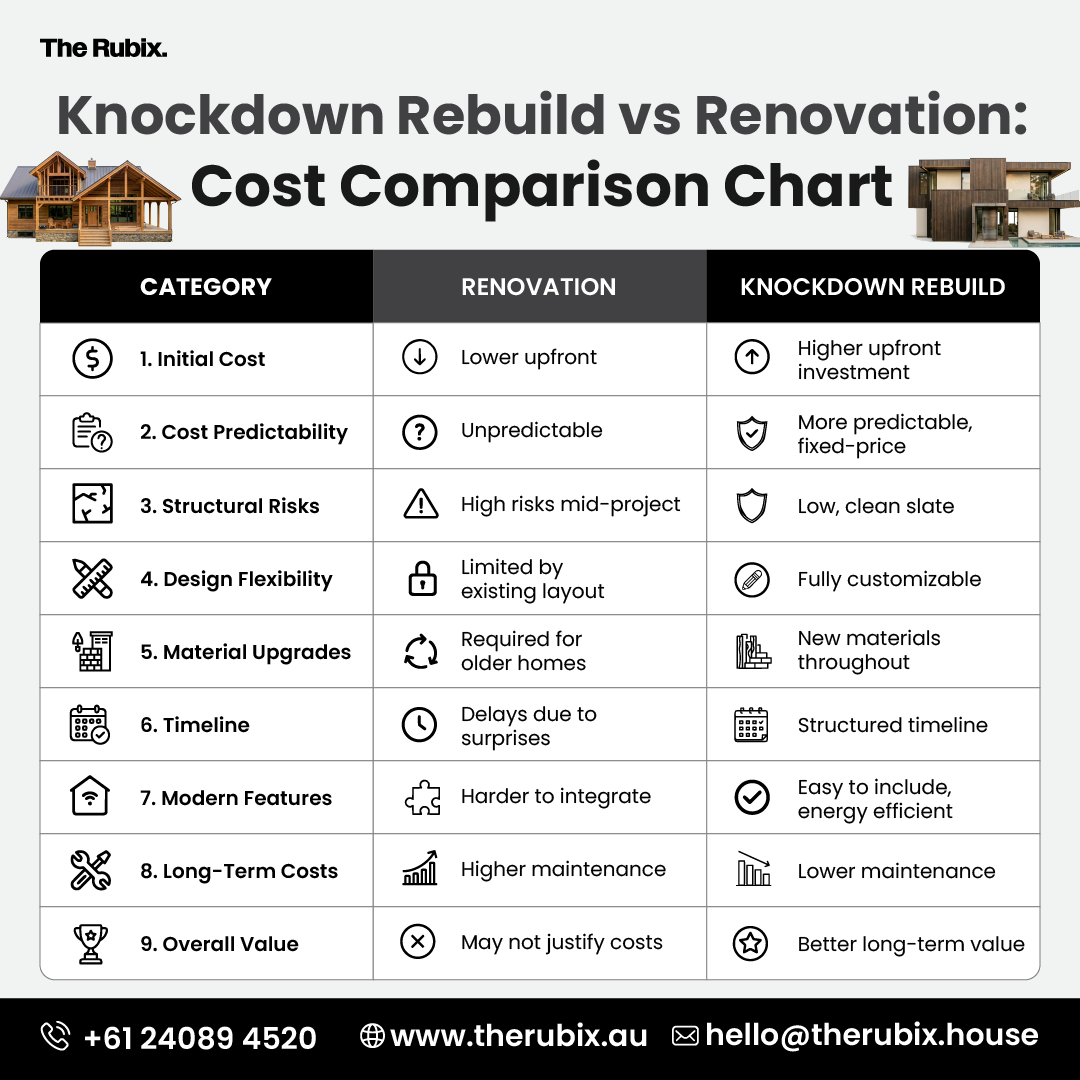
Knockdown Rebuild vs Renovation: Cost Comparison
One of the biggest dilemmas that homeowners face is whether to renovate or rebuild.
At first glance, renovation seems like the more affordable option but that’s not always the reality.
Renovation can become unpredictable when:
- Structural issues are uncovered mid-project.
- Existing layouts limit design improvements.
- Older materials require replacement or upgrades.
These unknowns can quickly push your project costs beyond the initial estimates.
Knockdown rebuild, on the other hand, offers:
- A clean slate with fewer structural surprises.
- Better cost predictability (especially with fixed-price contracts).
- Opportunity to design for modern living and energy efficiency.
While the upfront cost of rebuilding is typically higher, many homeowners find it delivers better long term value with fewer compromises and lower ongoing maintenance costs. Explore the complete knockdown rebuild guide in Australia to understand the full picture before you decide.
Hidden Costs You Shouldn’t Ignore
Even with a solid budget in place, certain costs often get overlooked until they start to show up later.
Here are some of the most common ones:
- Temporary accommodation during construction
- Demolition complications, such as asbestos removal
- Site preparation and excavation beyond initial estimates
- Utility connections and upgrades
- Landscaping, driveways, and fencing
- Council fees and compliance costs
- Interior upgrades and finishes not included in base quotes
Being aware of these early allows you to budget more accurately and avoid last-minute financial pressure.
Timeline and Cost Planning Tips
Delays in projects don’t just affect your schedule but directly impact your budget. Planning every detail thoughtfully and carefully is important to keep things on track.
Here are some tips from The Rubix:
- Finalise your design before approvals as changes during or after approval stages can lead to delays and additional costs.
- Choose a clear timeline and well-defined process with your building designer, as transparency upfront reduces uncertainty later.
- Avoid peak construction periods where possible as high demand can increase both labour costs and waiting times.
- Plan your selections early as late decisions on materials or finishes can slow down your progress.
- Consider faster construction methods like prefabrication or CLT to shorten build time and reduce labour expenses.
If you are considering an environmentally friendly building material, you can check our article on how CLT fares in terms of sustainability.
Takeaway
A knockdown rebuild in Sydney can feel complex but it doesn’t have to feel unpredictable. Most challenges in the budget come down to uncertainty, late decisions, and underestimating key cost drivers.
With the right approach and the right knockdown rebuild specialist you can stay in control and choosing smarter construction methods like CLT helps you balance design, performance, and cost without any compromise.
If you’re considering a knockdown rebuild in NSW and want clarity around costs, design, and what’s realistically achievable on your site, contact The Rubix here to schedule a meeting.
FREQUENTLY ASKED QUESTIONS
1. Is it cheaper to renovate or knockdown rebuild?
Between renovation and knockdown rebuild, the cheaper alternative depends on the extent of your project and the existing condition of your house. While renovation sounds cheaper, finding structural or service issues mid-project quickly escalates the budget.
2. How much does it cost to knock down a wall?
The cost to knock down a wall depends on whether the wall is load-bearing, its size, the rectification to the ceiling and flooring necessary, and the material used. This cost can start from $1500 for non-load bearing and go up to $10,000 + for load-bearing walls.
3. What is the most expensive part of a house renovation?
As an alteration, the most expensive part of a house renovation is the kitchen. This higher cost is due to the requirement of high-end materials and a variety of different trades (plumbers, electricians, cabinetmakers, tilers, and appliance installers). Expense is often high in additions for the site prep, foundations/slab and the roof.
4. What is the cheapest way to demolish a house?
The cheapest way to demolish a house is to seek help from a house removal service and salvage any valuable materials before starting the demolition.
5. Is it cheaper to knock down and rebuild or renovate my current house?
Whether it is cheaper to knock down and rebuild or renovate your current house totally depends on the age of your house, its existing condition, and structural integrity.