
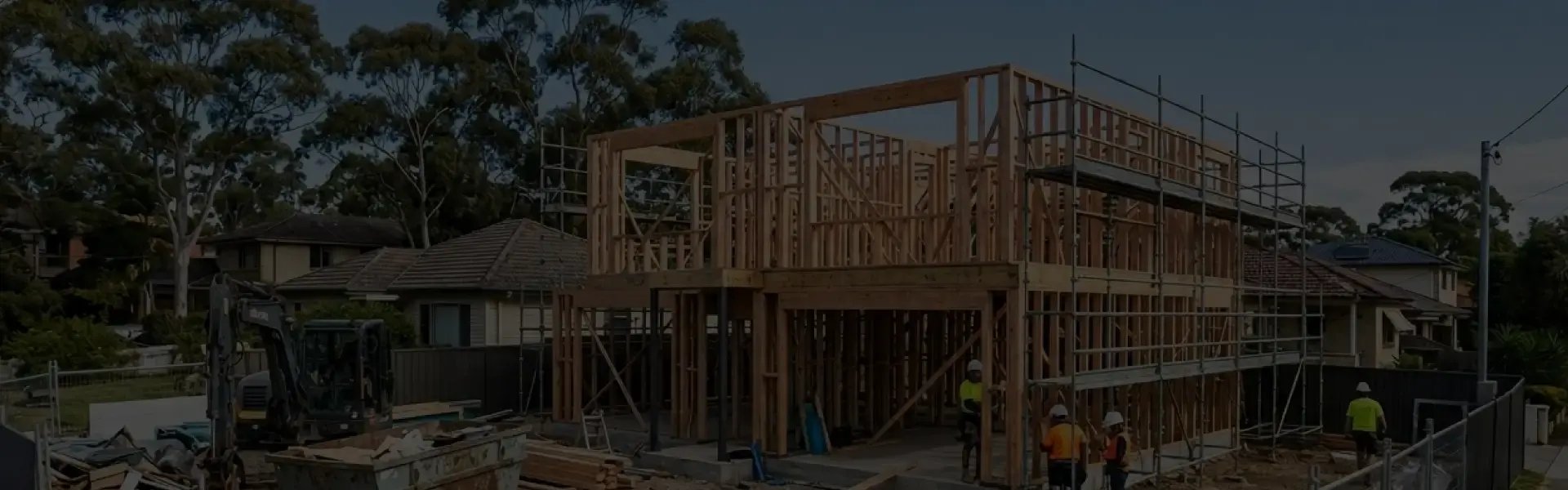

At some point, every homeowner asks the same question: Should we renovate or start again? As lifestyles evolve and family needs change, this decision becomes almost inevitable.
While rebuilding may seem like a significant financial commitment, it can often be a smarter long-term investment than relocating altogether. It saves you from sacrificing your location, community, and convenience and allows you to create a home that truly fits your life, right where you are.
In this guide by The Rubix, we’ll walk you through everything you need to know about knockdown rebuilds in Australia, from the process and key benefits to how choosing the right architect can shape the outcome.
What is a Knockdown Rebuild?
A knockdown rebuild is a construction process where your existing home is demolished and a brand-new home is built on the same block. It is a practical alternative to relocating, as you can stay in your current neighbourhood while still upgrading to a modern, purpose-built home.
In major cities of Australia like Sydney, Melbourne, and Perth, knockdown rebuilds account for a significant portion of new detached dwelling approvals.
Benefits of Knockdown Rebuild in Australia
Here’s why rebuilding is gaining strong momentum among homeowners in Australia:
- You can keep your proximity to schools, workplaces, and local amenities without the disruption of moving.
- You can create a modern, functional space that’s tailored to your needs, whether that’s open-plan living, flexible workspaces, or future-proof design.
- Rebuilding eliminates the uncertainty that comes with renovations like structural issues that quickly escalate budgets and timelines.
- You can avoid expenses like stamp duty and many transaction-related fees associated with buying a new home.
- A newly built home with contemporary features and finishes can significantly boost the resale value of your property.
- You can incorporate energy-efficient systems and modern materials such as Cross Laminated Timber to reduce environmental impact and long-term energy costs.
Is a knockdown rebuild right for your property?
If you’re still struggling to make a decision, a knockdown rebuild may be the right choice if:
- Your home has structural issues or ageing systems
- The layout can’t be improved without a major compromise
- Renovation costs are approaching rebuild costs
- You want complete design freedom
- You’re planning long-term and thinking beyond short-term fixes
A proper site and planning assessment can quickly determine what’s possible and what’s worth pursuing for your rebuild project.
Knockdown Rebuild Cost in Australia (2026 Guide)
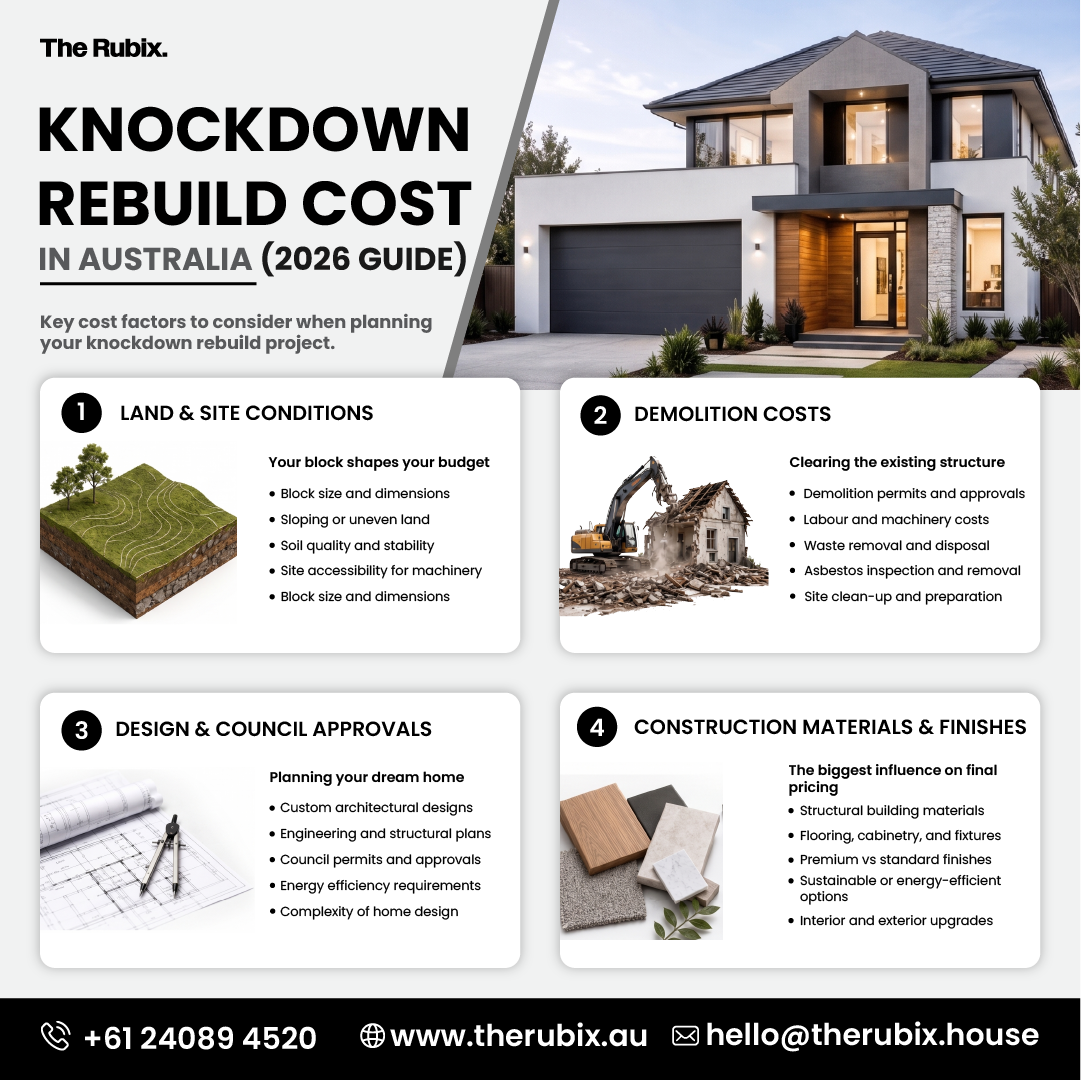
Key Cost factors (land, demolition, design, materials)
Several elements influence the overall cost of a knockdown rebuild, including:
Land and site conditions
The size, slope, soil quality, and accessibility of your block can impact excavation, preparation, and construction complexity.
Demolition costs
Removing your existing structure typically includes permits, labour, waste removal, and potential asbestos handling, all of which add to the total cost.
Design and approvals
Custom architectural designs, engineering, and council approvals can vary widely depending on the complexity of your vision.
Construction materials and finishes
The quality and type of materials you choose, both structural and aesthetic, play a major role in determining your final build cost.
How Material Choice Impacts Cost
Material selection is one of the most influential cost drivers in any rebuild project. While traditional materials like brick and concrete are often seen as cost-effective upfront, they can come with longer construction timelines and higher labour costs.
Some other modern materials and systems like prefabricated CLT panels reduce on-site delays with their quick and precise assembly. This lowers both your labour costs and your construction time too, so you get your new house in a shorter time than traditional builds.
CLT vs Traditional Materials: Cost & Long-Term Value
Cross Laminated Timber (CLT) is emerging as a smarter alternative in residential construction for its quicker build, efficiency, and sustainability.
Here’s how it compares to traditional materials:
Upfront Cost
While CLT may appear higher in initial cost compared to traditional materials, it must be viewed in the context of the total project cost and not just materials.
Faster Construction
Because CLT panels are prefabricated, they arrive ready to install. This reduces build time, cuts down labour costs and holding expenses.
Holding Costs
If you hold a mortgage on your land or plan to rent during this time, these represent a significant cost to factor in. If your house can be built with CLT in up to half the time as traditional methods this cost saving can be substantial.
Predictability
Less reliance on on-site work means fewer delays, less waste, and more consistent outcomes than traditional builds.
Energy Efficiency
CLT offers excellent thermal performance, helping reduce your heating and cooling costs over time.
Sustainability
As a renewable material with lower embodied carbon, CLT supports environmentally responsible building that’s being increasingly preferred in Australia.
Long-Term Value
When you factor in time savings, energy performance, and durability, CLT often delivers stronger value over the life of the home.
Step-by-Step Knockdown Rebuild Process in Australia
A knockdown rebuild might feel complex at first but when broken down, it follows a clear and structured path. Here’s how a knockdown rebuild project unfolds:
1. Site Assessment & Pre-Planning
Evaluation of zoning, council regulations, site conditions, and feasibility ensuring the project aligns with your goals and budget.
2. Design Phase
Working with an architect or building designer to create a home tailored to your lifestyle, block, and long-term needs.
3. Approvals (DA/CC or CDC)
Your architect or building designer will prepare the necessary planning and construction drawings to secure the approvals required to construct the rebuild.
4. Demolition
After selecting a builder, the existing structure of your house is safely removed and the site is prepared for construction.
5. Construction
The construction of your new home begins. The materials and construction method you chose plays a key role here, modern systems like prefabrication or CLT can improve speed, efficiency, and predictability.
6. Completion & Handover
Your knockdown rebuild builder will make the final inspections, check certifications and move-in readiness so you can move into your new home.
Council Approval for Knockdown Rebuild in Australia
Getting approval for knockdown rebuild in Newcastle or Lake Macquarie is essential. These come in two forms: a CDC, which is fast-tracked but can be restrictive, with decisions made solely between a private certifier and the NSW government with little room for dialogue; or a DA/CC, which moves more slowly through council but opens genuine conversation between you, your architect/designer, and the assessment team.
Either way, your rebuild architect or building designer project manages this approval process, ensuring your building design complies fully with the CDC requirements, or, in the case of DA/CC, ensuring any proposed departures from the local Development Control Plans (DCP) are a calculated risk and can be argued on merit.
At The Rubix, we help you with everything from initial concepts to the execution of your rebuild project. Contact us to start the discussion.
How to Choose the Right Knockdown Rebuild Architect or Designer
Your architect or building designer is more than just a consultant, they're your guide through one of the biggest decisions you’ll make.
Look for a knockdown rebuild specialist who:
- Offers end-to-end project management.
- Provides clear, transparent pricing.
- Understands both design and construction.
- Has experience with modern building systems like CLT.
- Focuses on long-term performance and not just delivery.
If you’re considering a rebuild, speaking with The Rubix early can help you understand what’s possible before committing to a direction.
Knockdown Rebuild Timeline in Australia
Finalizing design and permits for a new home, depending on approval timelines, construction detailing and finding a builder take about 12 months. The rebuild construction usually takes 12 to 18 months, depending design complexity, site conditions, and construction method.
The construction method and material you choose are especially important as they directly impacts how long the construction takes. Traditional builds can be affected by weather, labour availability, and sequencing delays.
Prefabricated systems like CLT reduce these risks, leading to faster and more predictable timelines for knockdown rebuilds in Newcastle and other cities of NSW.
Common Knockdown Rebuild Challenges (and Solutions)
Even well-planned rebuilds can face challenges but most are predictable and manageable with the right approach. Let’s discuss some common rebuild challenges and their possible solutions:
1. Delays and timeline blowouts
Choosing efficient construction methods and experienced architects or building designers leads to faster, more streamlined processes, keeping your project on track.
2. Budget uncertainty
Prioritise transparent costing and detailed planning early. Clear scope definition will help avoid unexpected expenses later.
3. Site constraints
Conduct thorough feasibility assessments upfront. Understanding your block’s conditions early prevents costly adjustments during construction.
4. Energy inefficiency in new builds
Use high-performance materials and systems from the start. Smarter construction choices can improve comfort and reduce long-term energy costs.
Knockdown Rebuild vs Renovation: Which is Better?
If you’re still second-guessing, here’s how you can decide between knockdown rebuild and renovation:
Choose a knockdown rebuild if:
-
Your home has major structural or layout limitations
- You want full design freedom and long-term performance
- Your renovation costs are escalating
Choose renovation if:
-
The building is structurally sound
- The changes you need are relatively minor
- Heritage restrictions prevent demolition of your house
In many cases, homeowners begin with renovation but shift to rebuilding once they understand the full picture.
Knockdown Rebuild Projects by The Rubix
At The Rubix, we approach knockdown rebuilds differently. They are not just construction projects but opportunities to build smarter.
That means:
- Designing with intent, not limitation.
- Reducing inefficiencies in the build process.
- Leveraging high-performance systems like CLT where they create real value.
- Delivering homes built for long-term performance and not short-term fixes.
You can check out our past CLT projects to understand how it can support your lifestyle and sustainability goals.
Takeaway
Knockdown rebuild is a great way to upgrade your home without the hassle of relocation. While the process can feel complex, the right architect or building designer can simplify it significantly.
Choosing prefabricated systems like CLT gives you an extra edge by reducing both your construction time and labour costs while still giving you designing flexibility.
At The Rubix, we offer tailored design solutions to build homes that fit your lifestyle. Contact us to discuss rebuilding and renovation using traditional and modern materials like CLT.
FREQUENTLY ASKED QUESTIONS
1. What is a knockdown rebuild in NSW?
A knockdown rebuild in NSW is a construction method where you demolish your existing house to build a new home.
2. How much does a knockdown rebuild cost in NSW?
The cost of a knockdown rebuild in NSW depends highly on the site conditions, demolition and labour costs, and the construction material you choose.
3. What is the cost of a knockdown rebuild duplex in NSW?
The cost of a knockdown rebuild duplex in NSW varies based on the site, design, and the finish you want. As the duplex will have two structures, the cost will be significantly higher, but still cheaper than two standalone homes.
4. Is a knockdown rebuild cheaper than renovation in NSW?
Whether a knockdown rebuild is cheaper than renovation in NSW depends on the scope of your project. For a simple renovation it can be cheaper but if any structural or services issues come to light, it can quickly surpass rebuild costs.
5. How long does a knockdown rebuild take in NSW?
After design is complete and approvals attained, knockdown rebuilds usually takes 12 to 18 months in NSW. Using prefabricated systems like CLT can significantly reduce this time with its quick and precise assembly.
6. Do I need approval for a knockdown rebuild in NSW?
Yes, for a knockdown rebuild in NSW, you will need a council approval (DA/CC) or a certifier approval using NSW planning framework (CDC).
7. Do you need a DA approval or can you use Complying Development for new builds and renovations?
Designs that fully meet state-wide standards can move through a CDC quickly, though the requirements themselves can be more restrictive, particularly around setbacks and landscape ratios. DA approvals are more common precisely because local controls tend to be less rigid, and unlike a CDC, full compliance is not a strict requirement. Departures are discussed on their merit directly with an assigned council town planner. The trade-off is a higher cost and longer timeframe.