---
title: Is CLT a Budget Breaker or a Smart Investment? Let’s Crunch the Data
description: Explore whether CLT is a budget breaker or smart investment. Learn about CLT home costs, sustainability, durability and long term value in Australia.
image: https://therubix.au/hubfs/Is-CLT-a-Budget-Breaker-or-a-Smart-Investment-1.webp
---
[](https://therubix.au)
- [HOME](https://therubix.au)
- [ABOUT](https://therubix.au/about)
- [PROJECTS](https://therubix.au/projects)
- [CONTACT](https://therubix.au/contact-us)
Follow us on
-
-

# Is CLT a Budget Breaker or a Smart Investment? Let’s Crunch the Data
 [Ken Slamet](https://therubix.au/blog/author/ken-slamet)
| Oct 6, 2025
Cross Laminated Timber (CLT) has become one of the most talked-about building materials in recent years. Known for its sustainability, precision, and warm natural character, CLT is reshaping the way people think about new home design and construction. But there’s still one common question is CLT a budget breaker or a smart long-term investment?
If you’re considering building a cross laminated timber home or comparing construction options for your new home this guide breaks down what CLT is, why it’s gaining traction across Australia, and how its true cost compares over the life of a project.
### What is Cross Laminated Timber?
[Cross Laminated Timber](https://therubix.au/crosslaminatedtimber) (CLT) is an engineered wood product made by gluing layers of timber at right angles to each other. This cross-lamination creates panels that are remarkably strong, stable, and dimensionally accurate.
Developed in Austria during the early 1990s, CLT quickly spread across Europe and reached Australia in the mid-2010s with the completion of Melbourne’s Library at the Dock (2014) recognised as Australia’s first public building constructed primarily from CLT. Since then, designers and architects have embraced it for its efficiency, sustainability, and refined aesthetic.
### Why CLT is Gaining Popularity in Australia?
[Building with CLT in Australia](https://therubix.au/blog/building-with-clt-smart-sustainable-homes-in-australia) is increasingly being used in both residential and commercial projects for good reason. It combines beauty with performance offering a natural finish that brings warmth to interiors while helping to lower the carbon footprint of construction.
Because timber stores carbon absorbed during a tree’s growth, CLT effectively locks away CO₂ rather than emitting it, unlike concrete or steel. Its manufacturing process also consumes far less energy. Add to that its excellent fire resistance, seismic performance, and insulation qualities, and it’s easy to see why CLT is the preferred choice for sustainable and energy-efficient homes.
But sustainability alone doesn’t close the deal cost matters too.
### Understanding the Base Cost of CLT
At face value, CLT can appear more expensive than conventional materials. When compared with traditional lightweight construction or even with concrete and steel it generally carries a higher upfront material cost, though it often offsets this through faster build times and reduced labour and foundation expenses.
In Australia, local pricing is influenced by high demand and limited domestic supply, while European producers benefit from large-scale manufacturing that reduces unit cost. As a result, the landed cost of imported CLT is now roughly on par with locally produced panels.
Yet even when compared to other construction materials, this tells only part of the story. To understand the real value of CLT, it’s important to look beyond raw material costs and consider the full construction process.
### Hidden Cost Savings of CLT
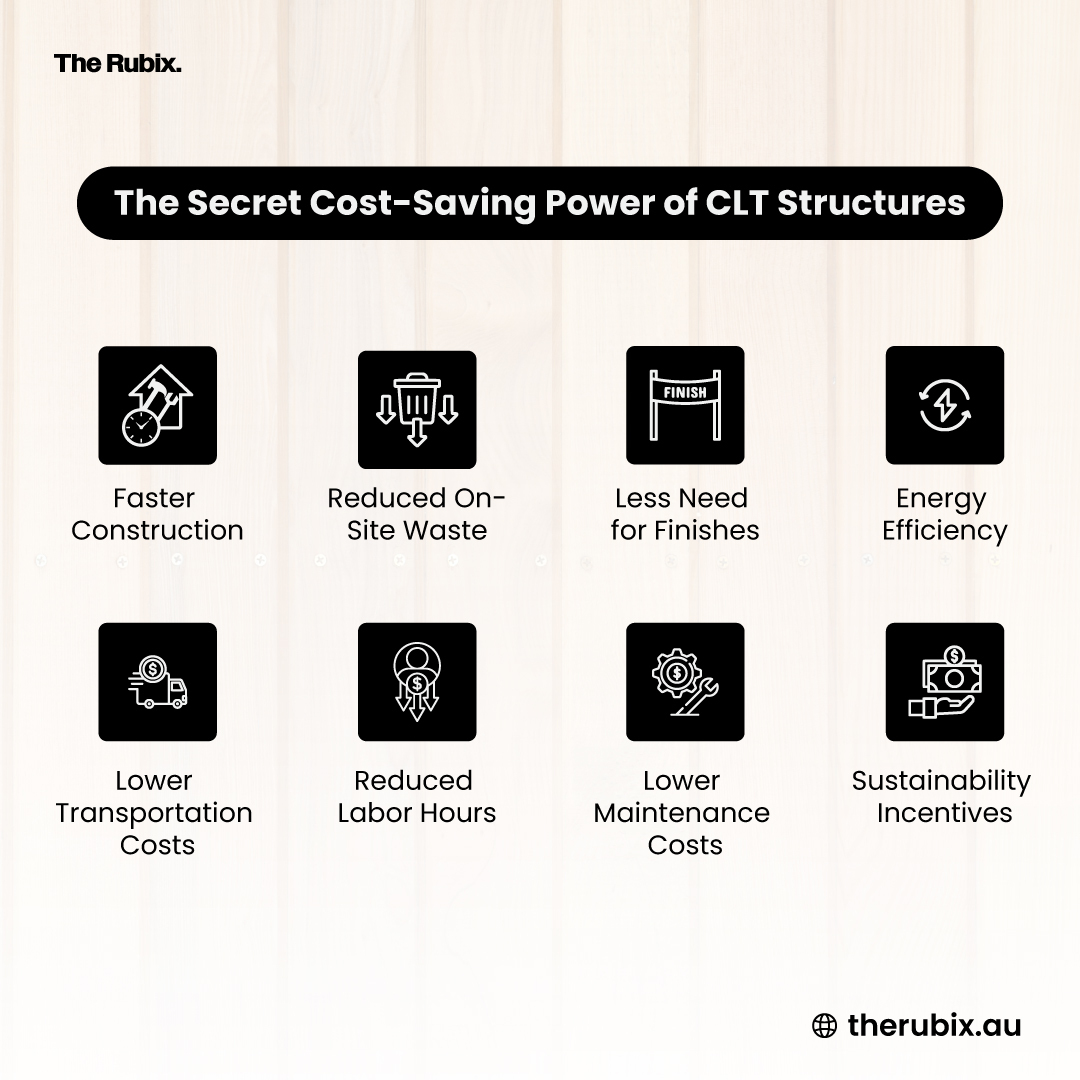
Despite a higher initial outlay, CLT offers several built-in savings that traditional materials simply can’t match, highlighting why the [benefits of a cross laminated timber house](https://therubix.au/blog/7-smart-reasons-to-invest-in-a-clt-home-this-year)extend well beyond the initial construction phase.
#### • Faster construction time
CLT panels are prefabricated off-site with computer-controlled precision. When they arrive on-site, they fit together quickly and accurately significantly shortening the overall build period. Faster completion can also mean lower temporary living expenses for homeowners who need to move out during construction or a faster return to occupancy for dual-dwelling projects.
#### • Reduced labour cost
In Australia, where labour is one of the largest components of building expense, CLT’s speed and accuracy deliver major cost savings. The reduction in on-site trades and shorter project timelines can, in many cases, offset the higher material cost making CLT competitive, and often cheaper, than conventional timber-framed construction.
#### • Predictable pricing and fewer errors
Because CLT is digitally fabricated, quantities are confirmed early and components arrive ready to assemble. This accuracy reduces cost variations, minimises site errors, and limits expensive call-backs or rework after completion. Understanding key [CLT construction details](https://therubix.au/blog/7-clt-construction-details-for-stronger-builds) during the design stage also helps ensure connections, openings, moisture protection, and services are properly coordinated.
#### • Reduced supervision and coordination cost
With fewer trades and a more streamlined installation process, site management becomes simpler and more efficient, lowering both builder and client overheads.
#### • Less waste, lower site costs
Prefabrication minimises offcuts and errors, reducing waste disposal costs and the number of days required on site.
These efficiencies don’t just save money they also reduce environmental impact and improve site safety.
### The Lifecycle Value of CLT
While the financial benefits of CLT are clear during construction, the value doesn’t stop there. CLT continues to perform long after the build is complete, offering energy efficiency, durability, and sustainability advantages that reduce operating and maintenance costs over time.
A lifecycle assessment measures the environmental and financial impact of a material from manufacturing through to end-of-life . Compared with [traditional timber construction](https://therubix.au/blog/from-timber-frames-to-clt-sustainable-construction), CLT consistently performs well across each stage, with panels that can often be reused or recycled when a building reaches the end of its life.
#### • Energy efficiency
CLT naturally regulates temperature thanks to its high thermal mass and low conductivity. Homes built from CLT need less heating and cooling, lowering ongoing energy costs.
#### • Durability and low maintenance
The cross-laminated structure makes CLT panels resistant to warping, cracking, and movement. When properly detailed, CLT buildings are airtight, durable, and require minimal maintenance, reducing long-term repair costs.
#### • Green Star and NABERS ratings
CLT construction can contribute to strong sustainability ratings under Australia’s Green Star and [NABERS](https://www.nabers.gov.au/)frameworks by lowering embodied carbon and construction waste.
### The Verdict: Budget Breaker or Smart Investment?
CLT may carry a higher material cost upfront, but in the Australian residential market where labour is expensive and time delays add up the total build cost can often be lower than traditional methods. When you factor in its speed of assembly, reduced labour requirements, predictable pricing, and long-term durability, CLT stands out as both an economical and future-focused choice.
Over its lifetime, a CLT home delivers measurable savings and strong environmental value, proving that smart design and sustainable materials don’t have to come at a premium.
##### Key cost advantages include:
- High energy efficiency
- Lower maintenance costs
- Reduced construction time and labour
- Predictable pricing
- Strength and longevity
### Planning to Build Using CLT?
At [The Rubix](https://therubix.au/), we design distinctive, sustainable new homes that make the most of CLT’s potential from single dwellings to dual occupancies. Every project is guided by a collaborative designer or architect approach, balancing innovation, warmth, and efficiency to create spaces that reflect who you are and how you live.
If you’re exploring whether CLT is right for your next home, [contact our team](https://therubix.au/contact-us)to discuss the possibilities.
> Real CLT Project Details You Can Learn From
> Learn from our standout cross laminated timber projects and see sustainability in action:
> View [The Long Lap project details](https://therubix.au/projects/the-long-lap)
> View[Lofty Beacon project details](https://therubix.au/projects/lofty-beacon)
## Frequently Asked Questions
#### Q1: Is CLT actually sustainable?
Yes, CLT is actually sustainable. This is owed to its resourcing from a renewable resource (wood), better Carbon sequestration, low CO2 emissions during its production, and energy efficiency of the building constructed using CLT.
#### Q2: What is CLT good for?
CLT (Cross Laminated Timber) is good for faster, sustainable, and stronger construction (wall, roof, and floor) as compared to the traditional concrete and steel. It offers better fire protection, energy efficiency, and carbon sequestration, too.
#### Q3: What is the lifespan of a CLT building?
The lifespan of a CLT building is 60-100 years. However, with proper maintenance and care to manage moisture and external environment, it can last for even longer like the CLT structures in Europe.
#### Q4: Is CLT fire proof?
CLT offers great fire resistance as its layers char slowly. This creates an insulating char layer that protects the unburnt side and delays its degradation to around 90 minutes, this allows enough time for escape and rescue.
#### Q5: Why choose CLT?
Choose CLT for its sustainable, fast, energy efficient, and strong construction that’s environment friendly and cost-effective. It is suitable for all projects from residential to mid-rise commercial constructions.
#### Q6: Can CLT be used for high-rise buildings?
Yes, CLT can be used for high-rise buildings with its strength and durability. However, it is best paired with traditional concrete and steel structures for buildings over 18 storeys.
[CLT -The Rubix](https://therubix.au/blog/tag/clt-the-rubix), [Cross Laminated Timbers](https://therubix.au/blog/tag/cross-laminated-timbers)
#### Subscribe to Our Newsletter!
### Free Trial
[](https://therubix.au/)
- [About](https://therubix.au/about)
- [Projects](https://therubix.au/projects)
- [Blog](https://therubix.au/blog)
- [Contact](https://therubix.au/contact-us)
Connect with us:
© The Rubix, 2026
Legal | Privacy | Cookies Settings
```json
{
"@context" : "https://schema.org",
"@type" : "BlogPosting",
"author" : {
"@type" : "Person",
"name" : "Ken Slamet",
"url" : "https://therubix.au/blog/author/ken-slamet"
},
"dateModified" : "2026-09-25T10:06:16.576Z",
"datePublished" : "2025-10-06T07:57:33.000Z",
"headline" : "Is CLT a Budget Breaker or a Smart Investment? Let’s Crunch the Data",
"image" : [ "https://therubix.au/hubfs/Is-CLT-a-Budget-Breaker-or-a-Smart-Investment-1.webp" ],
"mainEntityOfPage" : {
"@id" : "https://therubix.au/blog/clt-budget-breaker-or-smart-investment",
"@type" : "WebPage"
},
"publisher" : {
"@type" : "Organization",
"logo" : {
"@type" : "ImageObject",
"url" : "https://therubix.au/hubfs/The-Rubix-Collective-Logo-Black.svg"
}
}
}
```
```json
{
"@context" : "https://schema.org",
"@type" : "FAQPage",
"mainEntity" : [ {
"@type" : "Question",
"acceptedAnswer" : {
"@type" : "Answer",
"text" : "Yes, CLT is actually sustainable. This is owed to its resourcing from a renewable resource (wood), better carbon sequestration, low CO2 emissions during its production, and the energy efficiency of buildings constructed using CLT."
},
"name" : "Is CLT actually sustainable?"
}, {
"@type" : "Question",
"acceptedAnswer" : {
"@type" : "Answer",
"text" : "CLT (Cross Laminated Timber) is ideal for faster, sustainable, and stronger construction of walls, roofs, and floors compared to traditional concrete and steel. It also offers better fire resistance, energy efficiency, and carbon sequestration benefits."
},
"name" : "What is CLT good for?"
}, {
"@type" : "Question",
"acceptedAnswer" : {
"@type" : "Answer",
"text" : "The lifespan of a CLT building is typically between 60 and 100 years. With proper maintenance and moisture management, CLT structures can last even longer, as demonstrated by long-standing timber buildings in Europe."
},
"name" : "What is the lifespan of a CLT building?"
}, {
"@type" : "Question",
"acceptedAnswer" : {
"@type" : "Answer",
"text" : "CLT is not fireproof, but it offers excellent fire resistance. Its layers char slowly when exposed to fire, creating an insulating layer that protects the inner timber and can provide up to 90 minutes of fire resistance, allowing valuable time for evacuation and rescue."
},
"name" : "Is CLT fire proof?"
}, {
"@type" : "Question",
"acceptedAnswer" : {
"@type" : "Answer",
"text" : "CLT is chosen for its sustainability, construction speed, energy efficiency, strength, and environmental benefits. It is suitable for a wide range of projects, from residential homes to mid-rise commercial buildings."
},
"name" : "Why choose CLT?"
}, {
"@type" : "Question",
"acceptedAnswer" : {
"@type" : "Answer",
"text" : "Yes, CLT can be used for high-rise buildings due to its strength and durability. For buildings over 18 storeys, CLT is often combined with concrete and steel systems to achieve optimal structural performance and compliance."
},
"name" : "Can CLT be used for high-rise buildings?"
} ]
}
```